Select your language


Through southern Serbia and northern Macedonia again

September 29, 2026
The BLAGO team is heading to southern Serbia and North Macedonia. The plan is to visit the Monastery of Venerable Prohor of Pčinj in southern Serbia and the Monastery of Matejić (Matejče in Macedonian) in Macedonia. In the early morning hours, packing the equipment is made difficult by the lack of parking in Jagodina, but that is an old story, and we manage. Part of the team from Mladenovac (Zoran and Branko) joins us, and we set off on our journey.

During the drive, we are reminded of the hermitage of Prochorus of Pčinj, which we visited while filming the Staro Nagoričane monastery last year. According to legend, the hunter Diogenes met Saint Prochorus of Pčinj, who prophesied to him that he should go to Constantinople, where he would be proclaimed emperor, adding, "but do not forget me." Diogenes did so, became emperor (Byzantine emperor Romanus Diogenes IV), but forgot about the prophet. According to legend, the prophet appeared to him in a dream and reminded him of the promise, and Emperor Diogenes built a church (1067–1071) on the site where he found the relics of the Venerable Prochorus of Pčinj. The relics are placed in the monastery whereholy oilbegan to flow. During the reign of King Milutin (1282–1321), the church was renovated and painted by one of the most important Byzantine painters, Mihajlo Astrape. During the Turkish occupation, the monastery suffered great damage, but in 1570 the Turkish register states that the monastery had 15 monks. In the early 19th century, the monastery complex was expanded, and it still represents one of the largest monastery complexes in the Balkans.
We arrive in the village of Klenike, which is about 30 km south of Vranje, a few kilometers from the border with North Macedonia. The Monastery of the Venerable Prohor of Pčinj is located on the slopes of Mount Kozjak and the valley of the Pčinj River. The whiteness of the elegant church in the center of the monastery complex, which is approached by a semicircular, relatively steep road, is highlighted by the greenery of the surrounding forests. The complex of buildings that are part of the monastery estate is large and is in the process of renovation. The abbot of the monastery, hieromonk Seraphim, warmly welcomes us with a blessing from Bishop Timočki. After venerating the relics of the Venerable Prohor of Pčinj with a blessing and anointing the forehead with a small cross, the members of the BLAGO team begin work.


The monastery's wall paintings, a witness to time and the people who had the privilege of encountering them throughout the centuries, welcome us. Painting frescoes is a rewarding job, especially when discovering details for which Zoran Jovanović always has an explanation based on years of studying fresco painting and history. In the early afternoon, the abbot of the monastery invites us to lunch, and hospitality is felt at every turn. With sardines, potatoes, salad, and the local specialty samsa pie, a conversation about life in the monastery completes the picture of the climate we are in. In the afternoon, the work continues and comes to an end.
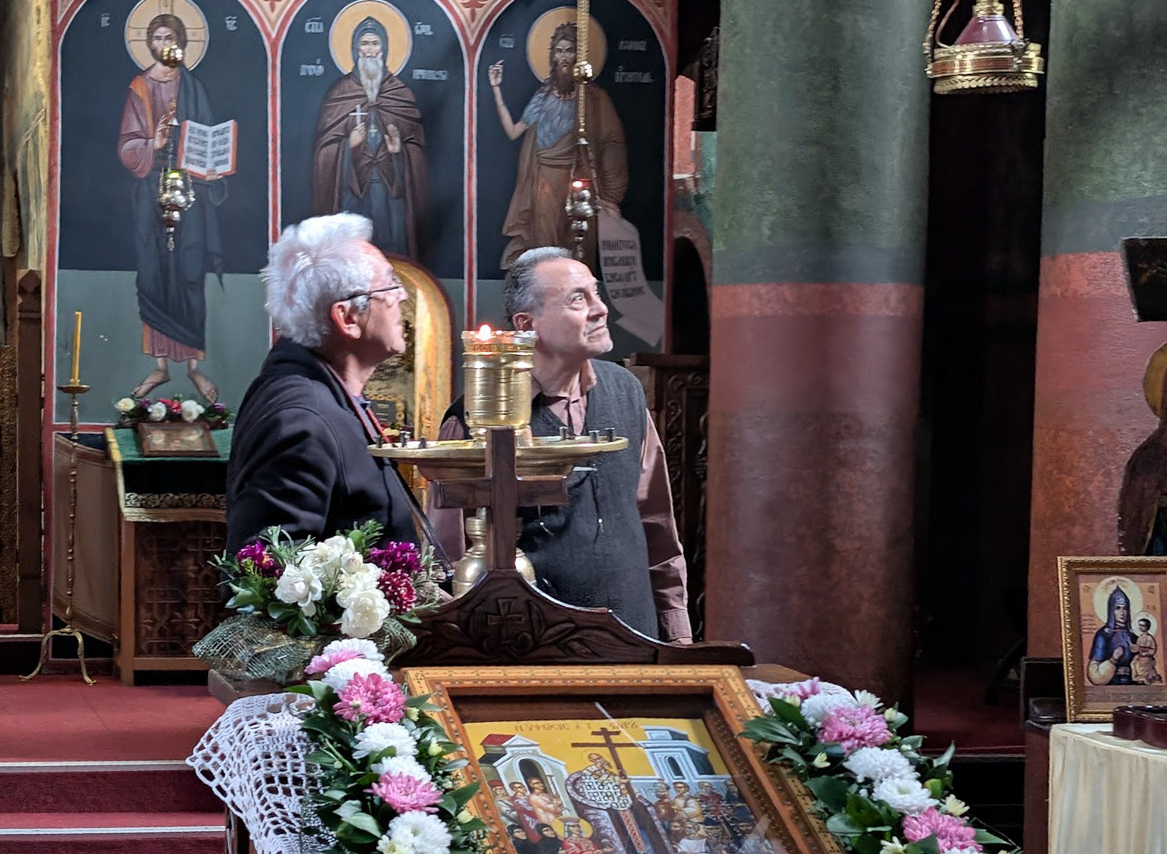
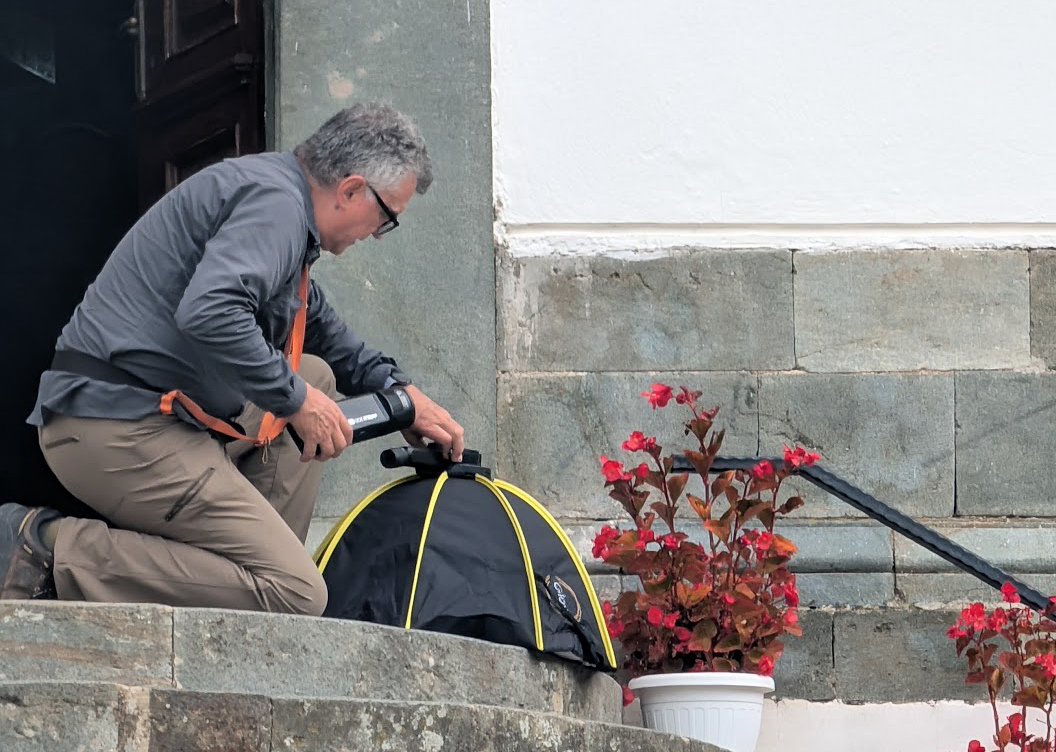
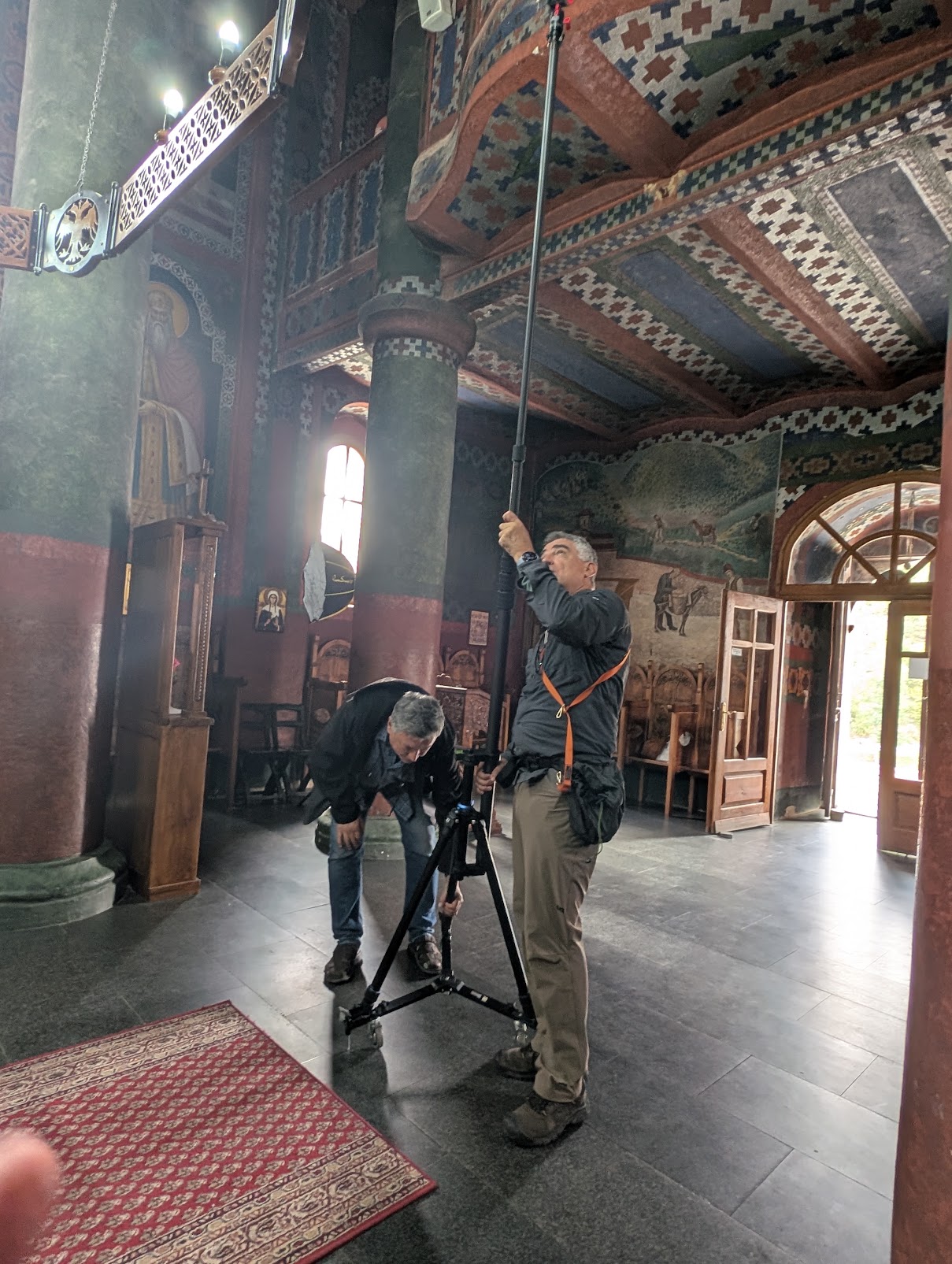

With gratitude for the privilege of being in the monastery and the hospitality shown, tired but grateful for the fulfilled filming schedule, we continue our journey towards Kumanovo in the late afternoon.
In Kumanovo (North Macedonia), Matejič Monastery
The slopes of Skopje Crna Gora in northern Macedonia overlook a valley that in these early autumn days resembles a beautiful carpet of warm colors. The Matejic Monastery is located above the village of Matejic, 13 kilometers from Kumanovo. On the way to Kumanovo, we are reminded of the history of the monastery. From stories and historical data, we know that we will have to face the harsh reality of the Balkans, where conflicts and destruction have been going on for centuries.
At the entrance to Kumanovo is our hotel Harmonija, where we are kindly welcomed. Our guide, Marjan Borović Skorupan, immediately explains that he is our host and proudly begins the story of a group of people from the area who decided to clean up the road, the monastery, and the monastery courtyard and regularly visit the monastery. The monastery has no electricity or water, and the road was almost impassable, but Marjan and his friends, with effort and financial resources, managed to clean up the road, the courtyard, the church, and begin clearing out the rooms that were not completely burned down during the conflict at the beginning of the 21st century. With great love, Marjan talks about the godfather of the monastery slava, which is celebrated every year in the monastery on Vavedenje. Being a godfather has become very popular because, since the slava was renewed in the monastery, whoever was a godfather the following year had a child. In recent years, they have had to hold a lottery to determine who would be the godfather due to the great interest. At the last celebration this year, Bishop Grigorije and over 200 guests were present. Marjan was born in the village of Matejic and spent many happy days with his friends and family in the monastery's resort. In 2001, he had to leave Matejic together with all the Serbs from the village, but "the monastery is not abandoned," adds Marjan, "it is in us and we in it forever."
The road to the monastery leads through what was once a very dense beech forest, which belongs to the monastery, but which has been reduced by conflict and illegal logging over the last 20 years to new plantings that look more like dense bushes than the once impressive beech forest. As we drive along the narrow road that a group of believers from Kumanovo has begun to maintain, the sound of a chainsaw in the forest shatters the silence and confirms that the unrest in these beautiful areas has not passed.
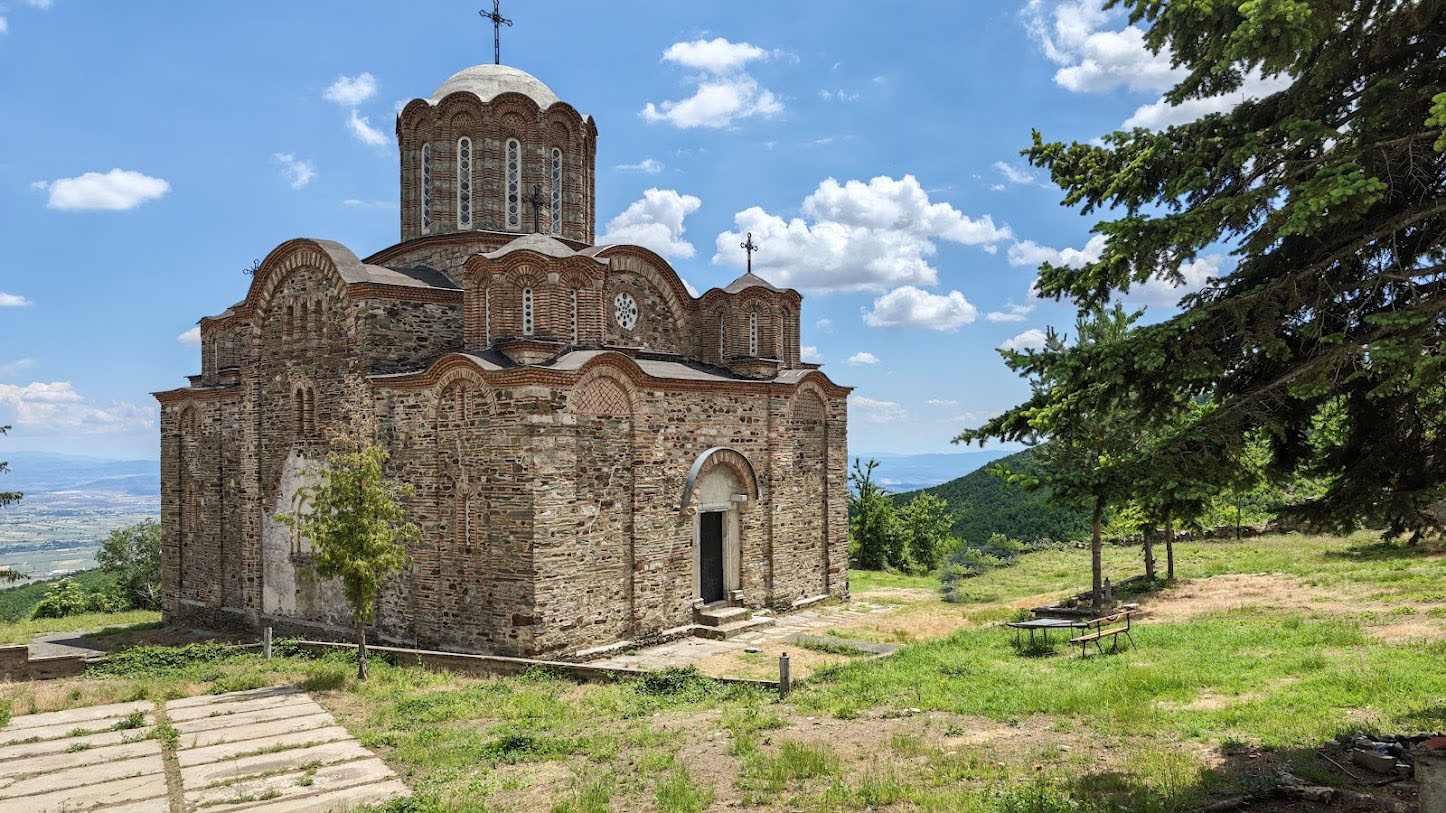
The monastery is dedicated to the Assumption of the Blessed Virgin Mary. In the 14th century, Emperor Dušan began the construction of the monastery on the foundations of an 11th-century Byzantine church, and his son Uroš and his wife Jelena completed the construction. The foundation composition depicts Queen Jelena and King Uroš with a representation of the temple in their hands, while Emperor Dušan is depicted next to them in a special fresco. The monastery served as one of the main spiritual and educational centers of the Middle Ages. In the 15th century, the composer of medieval music Isaija the Serb and the scribe Vladislav Grammatik stayed in the monastery.
The Turkish occupation brought destruction, including the removal of the monastery's lead roof in the 18th century, which was used to cover the Eski Mosque in Kumanovo. The temple was roofless for two centuries before restoration began in the early 20th century. During the conflict in this part of the Balkans in the early 21st century, the monastery was used as a military base and ammunition depot, causing extensive damage to the church and surrounding buildings, which is still visible today.

The church is imposing, both in size and in its magnificent architecture and location. The monastery’s five domes overlook a valley that is hard to look away from. In the monastery courtyard are the ruined remains of a building that was once a resort. In the distance is the bell tower. The monastery is always open, and Marjan points to a metal beam above the monastery door that replaced a broken wooden beam and thus prevented a large crack from spreading towards the main dome of the church.
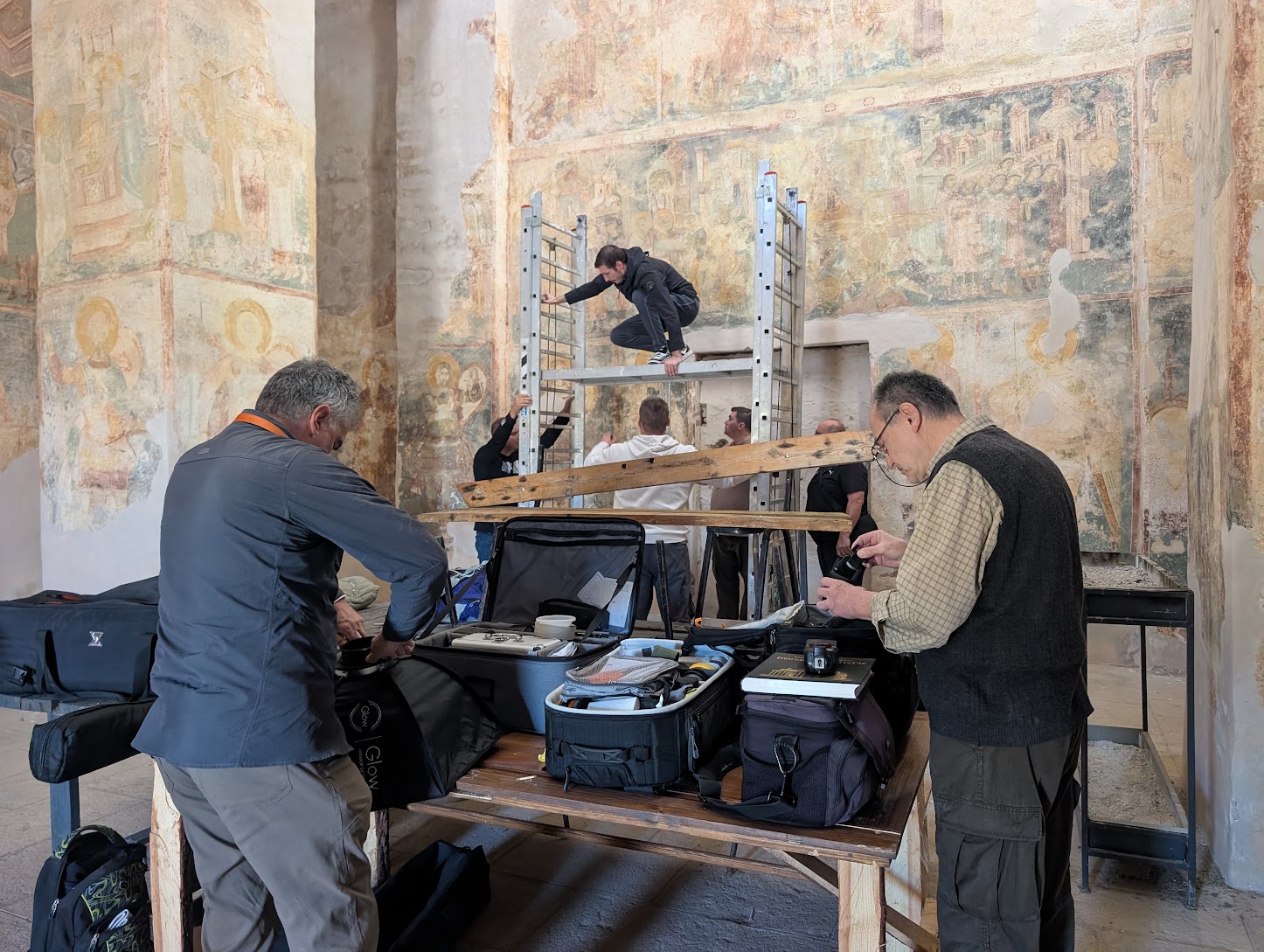
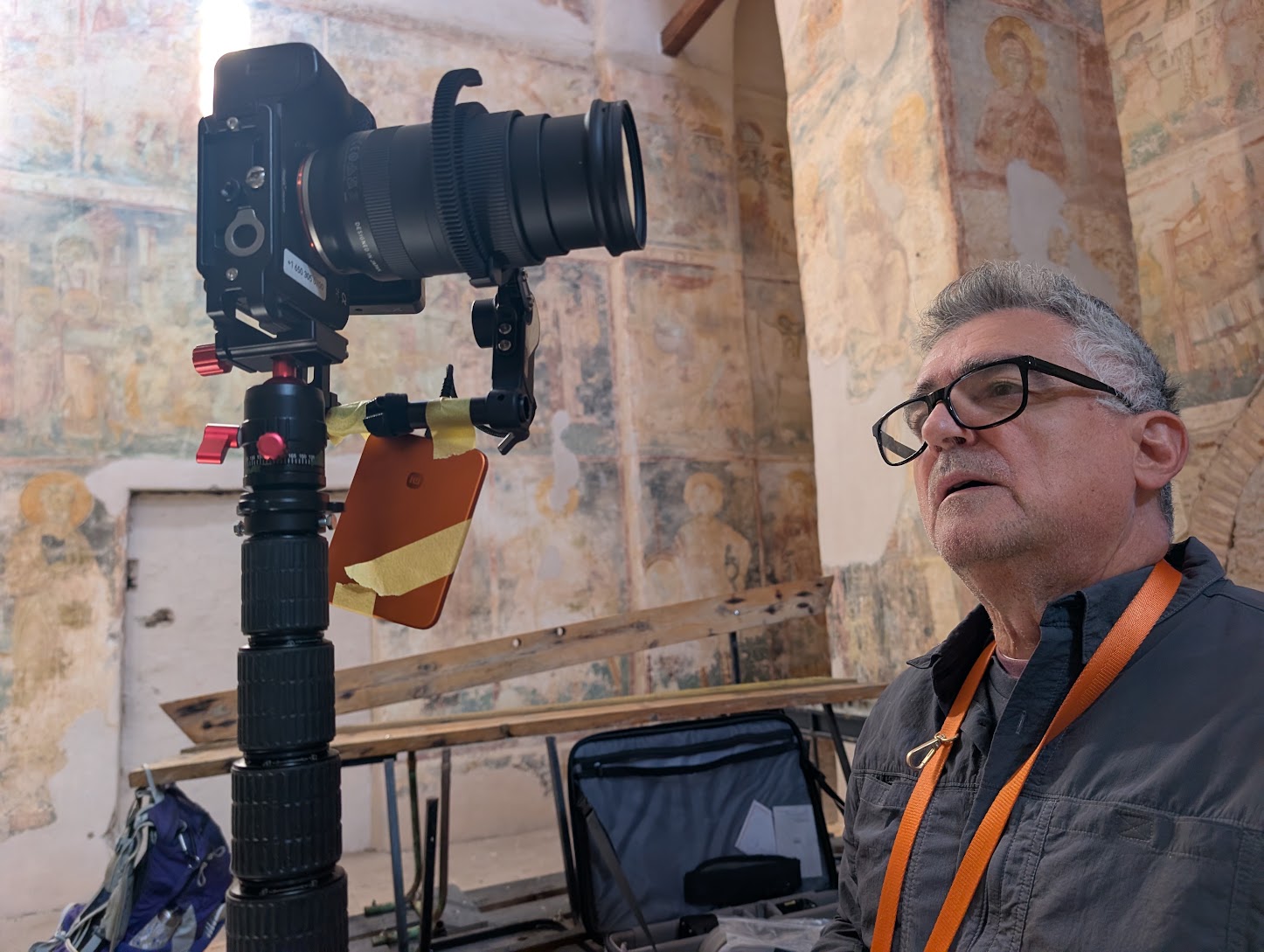
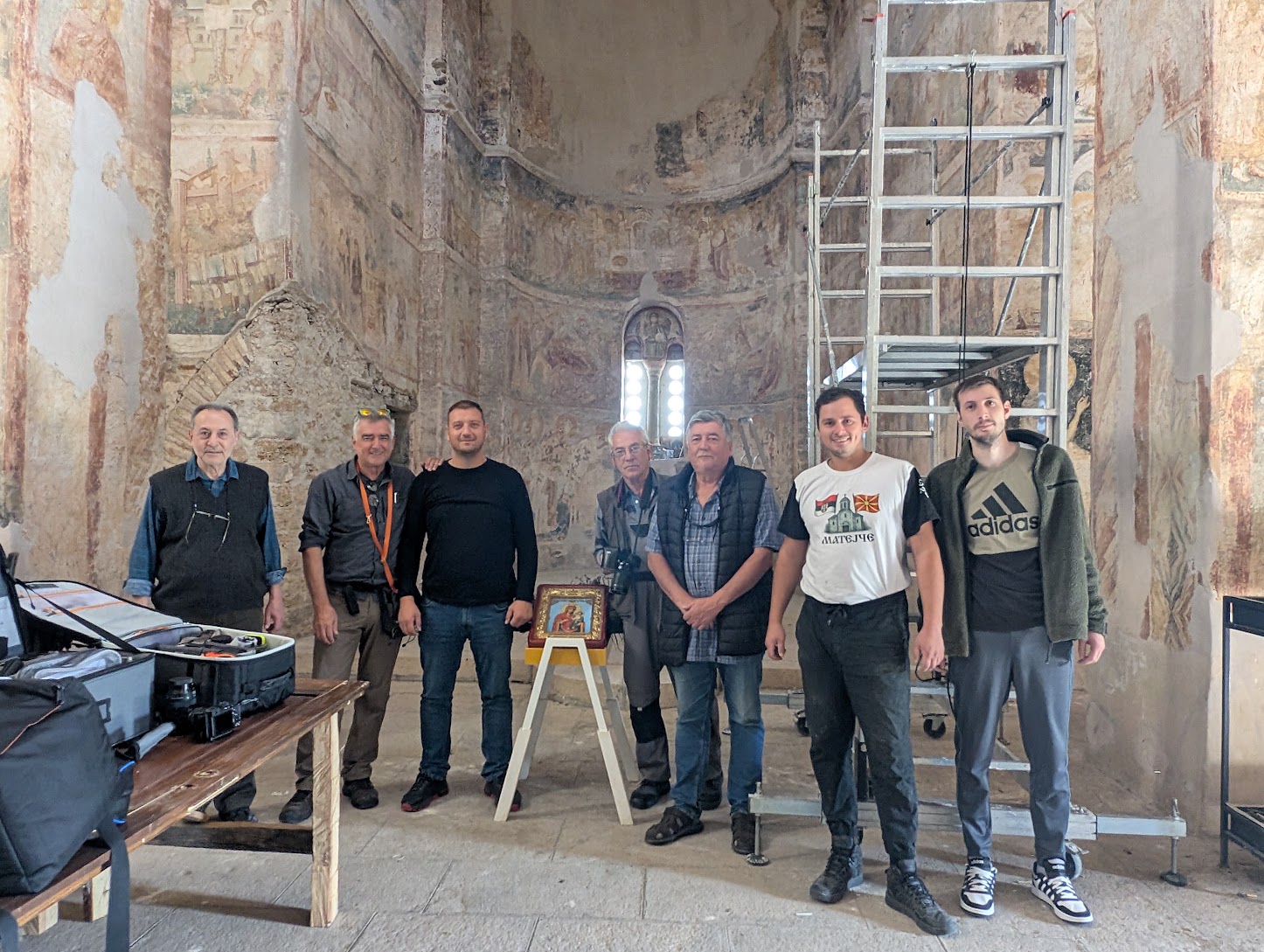
Around 2 o'clock, Marjan calls for lunch — we brought sandwiches for everyone, but to loud disapproval, the hosts bring out a tray of beans (tavče na gravče) with tomato salad and baked fish! A real feast. With stories and delicious food, time flies, and work awaits. Back to work until the sun sets.
Upon returning to the hotel, the evening is also a busy one, with material to be reviewed, batteries to be charged, and preparations to be made for the next day.
The second day in Kumanovo, and after an early breakfast, we head towards the monastery. Today we will be joined by Dr. Sasho Cvetkovski from the Macedonian Academy of Sciences and Arts (MANU), one of the top experts on medieval art in Macedonia and beyond. Once again, driving on a narrow road, with curves and some deep potholes, passing through villages where there are very modern new houses next to new mosques with no visible residents. Other villages are a bit different — there are no new houses — the difference is obvious.
The day is busy. Parts of the narthex and altar floors have been dug up and have been there for years. Marjan says that the Monument Protection Office has forbidden them to repair them, but the holes and moisture threaten to further damage the walls. The excavations are the work of vandalism and a search for treasure supposedly buried there. The scaffolding moves easily around the empty church, and being at the same height as the frescoes in the upper rows is always a special experience.


Today's lunch is a real feast! Even ice cream cake was served even though the monastery has no electricity or water. We talked with friends of the monastery about plans and how to move forward. Nenad and I see new hope. A few monks can revive this monastery and continue the path to a better future. We remember the monastery of St. Demetrius in Sušica, which was restored in this way.
After lunch, there remains the altar area and the difficult-to-reach frescoes in the arches between the columns. We are making slow progress. Each time the light enters through the different windows, the special details of the frescoes attract attention and remind us that the changes are not just centuries old. Sunset signals the end of the work — everything is recorded. Glory to the Lord!
The scaffolding has already been dismantled and packed. We are putting everything back in its place and, with a bow before the icon of the Virgin Mary and the saints who surround us, we are closing the doors of this beautiful temple. Closing the doors does not mean leaving forever. We hope that the journey will bring us back, and we cordially invite new friends who have selflessly helped and hosted us to be our dear guests in Jagodina or California.

With the blessing of Bishop Grigorije, the Kumanovo-Osogovo Diocese, the visit to Kumanovo and the work at the Matijić Monastery were carried out in cooperation with the Macedonian and Serbian Academies of Sciences and Arts (MANU and SANU).
Macedonian Academy of Sciences and Arts (MANU): Dr. Saso Cvetkovski
Kumanovo hosts: Marjan Borović Skorupan, David Stoševski, Tošo Dimkovski, Nikola Trajković
BLAGO team: Zoran and Branko Jovanović, Zoran Vukićević, Nenad and Jelena Vukićević
More Information
BLAGO Content
All BLAGO material is free to use, but there are certain rules for commercial use, as well as rules for citing the source of the material. See the following links for more information.
BLAGO also accepts material for its collection. Please contact us if you have any.
Contact
BLAGO Fund, Inc.
PO Box 60524
Palo Alto, CA 94306
USA
info@blagofund.org