Select your language


Field Trip 2026 - Eastern Serbia
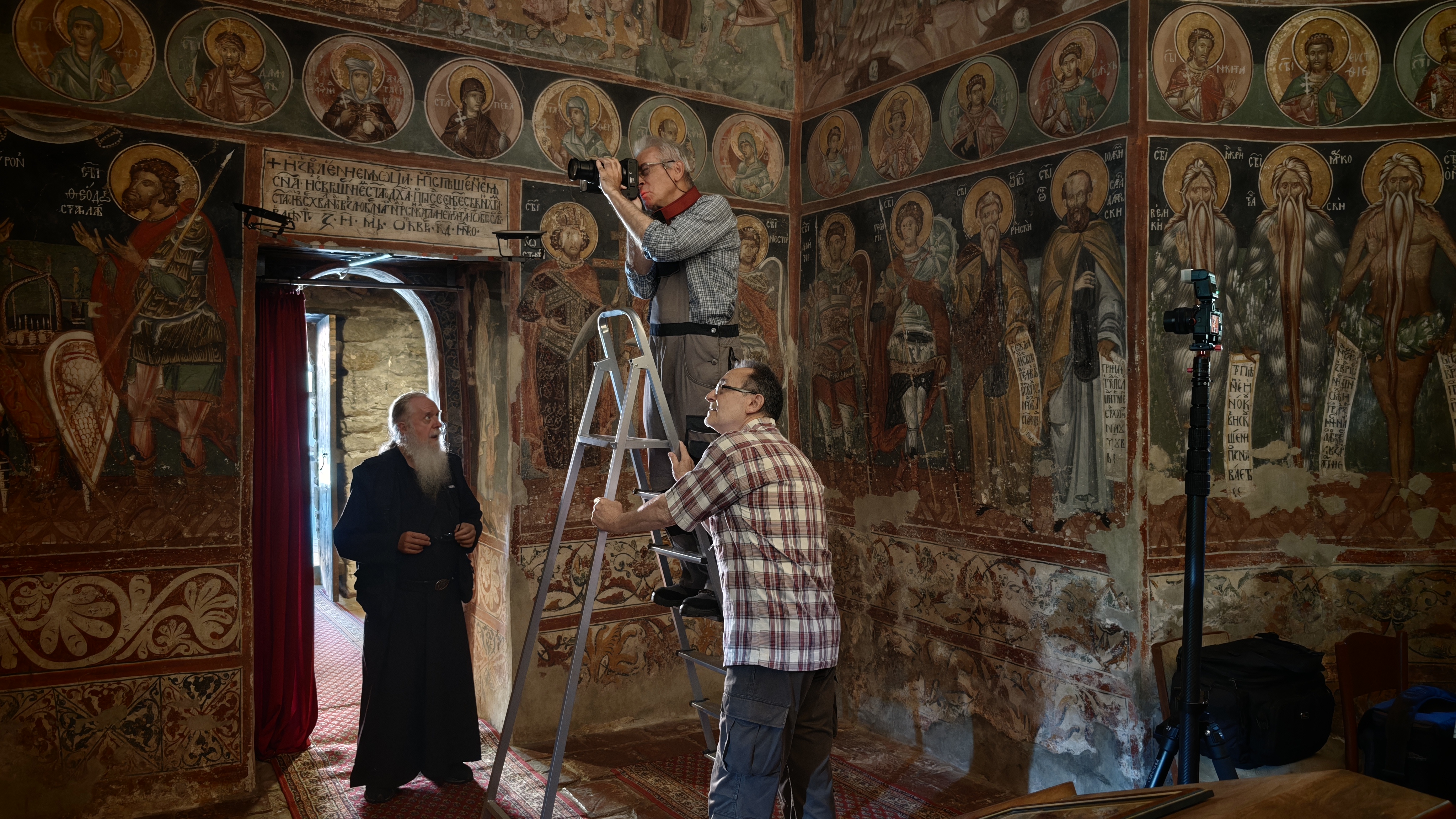
This year, the road led us to Eastern Serbia, which has many small but valuable and not adequately explored spiritual and cultural places. It is the area close to the Bulgarian and Macedonian borders; thus, the architecture and art are influenced partially by those two regions, although this is all closely aligned with the Byzantine Empire. Like the rest of the region, the heritage suffered enormous destruction and neglect during the long Turkish occupation.

Our
TEAM
Zoran and Branko Jovanovic, Nenad and Zoran Vukicevic
Krepičevac
Our first stop is Monastery Krepičevac, near the town of Boljevac, on the road between Paraćin and Zaječar. It is part of the Serbian church Timok Diocese, and lies at the foot of the Kučaj Mountains in the gorge of the Radovanjska River. However, the whole region is better known by the nearby mountain Rtanj.

Mountain
RTANJ
Rtanj Mountain (in the clouds during our visit) in eastern Serbia is known for its striking pyramidal shape and the rich biodiversity that covers its slopes. Many visitors are drawn to its highest peak, Šiljak, which offers expansive views and a sense of quiet, untouched wilderness. For more information on the mountain Rtanj, visit the Wikipedia page. It is unfortunate that the mountain is in the clouds during our visit.
After picking up the keys from Father Ristibor in Boljevac, we are off for another day of work, collection of the Monastery Krepicevac.

The church, dedicated to the Dormition of the Most Holy Mother of God, was built at an old cult site in the late fifteenth or early sixteenth century and is already recorded in Ottoman tax registers by 1531. The founders belonged to a respected Christian family permitted by Ottoman authorities to construct and paint the church. A partially preserved inscription reveals the dedication, while the north wall of the narthex preserves the full donor composition with legible names.

The ktetor Georgije, son of Jan, together with his wife Zora and their son Manojlo, offers a model of the church to the Mother of God. After this early period, the monastery disappears into the darkness of Ottoman rule and re-emerges only in 1761, when records mention the donation of a large wooden cross and iconostasis doors. Marginal notes in manuscripts attest to monastic presence, although the monastery has not been active in recent decades.
The church of Krepicevac is built on a triconch plan with a western narthex, covered by a semicylindrical vault beneath a single gabled roof. Acoustic ceramic vessels are embedded in the walls, and above the arched western entrance stands a large lunette depicting the Mother of God with Christ. The choir conches are set unusually far from the altar apse, creating a spacious eastern bay that accommodates a built altar screen with three arched openings and an arcosolium containing the tomb of Elder Josif, one of the Sinai monks of the late fourteenth century.

Fresco decoration is partially preserved: in the narthex are Christ Pantokrator, the Heavenly Liturgy, the donor portrait, and a Deesis; additional scenes include the Nativity of the Mother of God, compositions from the Akathist, and depictions of hermits and great schema monks. Fragmentary frescoes survive in the naos, including hierarchs, the Transfiguration, the Dormition, Pilate’s Judgment, and Saints Constantine and Helena. The altar screen once carried a full painted program, now preserved only in fragments. Conservation work was carried out between 1968 and 1974.
DONJA KAMENICA
Our next destination is Donja Kamenica, on the road to Pirot, eleven kilometers southeast of Knjaževac. The Church of the Holy Mother of God was built and painted in the first quarter of the fourteenth century by an unknown Bulgarian nobleman.


Although modest in size, the church achieves a sense of monumentality through carefully chosen architectural forms. Its plan is an irregular inscribed cross, created by reconstructing the western wall, while semicylindrical vaults over pendentives support the dome. The dome consists of a small cubic base and a circular drum with eight windows topped by a calotte.
To the west lies a two‑story narthex flanked by two smaller towers, and the donor model shows that a two‑story wooden porch once stood in front of it. Despite being built of roughly hewn stone, the exterior is enlivened by decorative bands of brick and ceramic vessels.

The interior is covered with frescoes of notable iconographic interest. The donor and his family are depicted on the lower level of the narthex, in one of the towers with a model of the church, and again in the southern choir with his brother and daughter. Scenes from the lives of Saint Nicholas and Saint Petka appear on the upper floor.
In the lower narthex, alongside the donor portrait, striking images of Saints Theodore Stratelates and Theodore Tiron on horseback, as well as Saint Demetrius and Saint Panteleimon, display dynamic movement and richly painted cloaks. Above them unfold scenes from the life of the Mother of God. In the naos, the program includes the Mother of God with Christ in the apse, the Adoration of the Lamb, the Great Feasts, and the Passion cycle. Preserved compositions include the Annunciation, the Visitation, the Nativity, the Entry into Jerusalem, the Resurrection, the Raising of Lazarus, the Dormition, the Last Supper, the Betrayal, the Mocking of Christ, the Lamentation, and the Myrrhbearers. The scenes are inscribed in Greek, while popular saints bear Old Church Slavonic labels.


STARA PLANINA
Donja Kamenica is in the foothills of Stara Planina mountain, which lies on the border between Serbia and Bulgaria. We could not resist visiting the mountain top and spending some time in nature.
MONASTERY POGANOVO
And, the pinnacle of our trip was the Monastery Poganovo.

The Monastery of St. John the Theologian stands near the village of Poganovo in southeastern Serbia, at the distant northern edge of the former domain of the Dejanović family, in the mythical landscape of the Jerma River. Hidden from sight by the steep cliffs of the Jerma Gorge and far from major roads, it has preserved the authentic atmosphere of a medieval Serbian monastery, along with the sense of uncertainty that marked the final decades of the fourteenth century. The name of the village itself suggests that a cultic structure existed here in pre‑Christian times. Behind the monastery walls, the memory of medieval splendor is kept alive by the church dedicated to St. John the Theologian, the medieval kitchen complex with its chimneyed hall and refectory, and the remains of monastic cells built in alternating layers of stone and brick. These structures were renewed in 1876, when a monastic residence was erected above the medieval refectory, and a beautifully proportioned wooden tower was built above the former granary, all enclosed by a perimeter wall with gates and auxiliary buildings.

The powerful lord Konstantin Dejanović completed the monastery before his death at Rovine in May 1395, as confirmed by a round medallion on the western façade. After his death, care for the monastery passed to his daughter Jelena, the only Serbian woman to become a Byzantine empress as the wife of Emperor Manuel II Palaiologos; her name appears in a second medallion.
The church itself is a triconch structure modeled on the Morava architectural group, though simpler in execution. Its polychrome walls, alternating stone and brick, and refined decorative elements—five‑sided apse, lively brick arches, round medallions, and a profiled dome—reflect both Morava and Byzantine traditions.

The frescoes, completed on October 24, 1499, include Christ Pantokrator in the dome, prophets in the drum, evangelists in the pendentives, the Great Feasts, the Passion cycle, and scenes dedicated to the Mother of God. Notable figures such as Saints Constantine and Helena, St. Sava, and St. Simeon Nemanja appear prominently. The painters came from Kastoria or nearby Linotopi, working alongside Serbian artists, as shown by inscriptions in the Serbian recension. Many treasures, including a celebrated double‑sided icon, were taken to Sofia during World War I. Conservation and research at the monastery complex began in 1966 and continued until 1974.

RIVER JERMA
The Jerma Canyon, located near the towns of Pirot and Dimitrovgrad, is narrow and dramatic, with sheer rock faces that rise like cathedrals on both sides of the water.


More Information
BLAGO Content
All BLAGO material is free to use, but there are certain rules for commercial use, as well as rules for citing the source of the material. See the following links for more information.
BLAGO also accepts material for its collection. Please contact us if you have any.
Contact
BLAGO Fund, Inc.
PO Box 60524
Palo Alto, CA 94306
USA
info@blagofund.org